
What is X-ray fluorescence (XRF)?
XRF is a fast, non-destructive way to measure exactly which elements make up a sample, by reading the characteristic X-rays each element gives off when excited. It is the science that powers REX.
How XRF works
When a primary X-ray excitation source, from an X-ray tube or a radioactive source, strikes a sample, the X-ray is either absorbed by the atom or scattered through the material. When an X-ray is absorbed by transferring all of its energy to an innermost electron, that is the photoelectric effect.
If the primary X-ray has enough energy, electrons are ejected from the inner shells, creating vacancies. As the atom returns to a stable state, electrons from the outer shells drop in to fill them, giving off a characteristic X-ray whose energy equals the difference between the binding energies of the two shells. Because every element has a unique set of energy levels, each emits X-rays at a unique set of energies, which lets XRF non-destructively measure a sample's elemental composition.
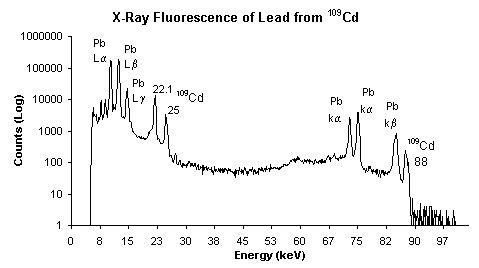
Reading the lines: K, L, M, and N
Characteristic X-rays are labeled K, L, M, or N to denote the shell they originated from. A second label, alpha, beta, or gamma, marks which higher shell the electron transitioned from. So a K-alpha X-ray comes from an electron moving from the L shell to the K shell, and a K-beta from the M shell to the K shell, and so on.
Why XRF is the method of choice
The XRF method is widely used to measure the elemental composition of materials. Because it is fast and non-destructive, it is the method of choice for field applications and industrial production control. Depending on the application, XRF can be produced not only with X-rays but also with alpha particles, protons, or high-energy electron beams.
A worked example: the Titanium atom (Ti, Z = 22)
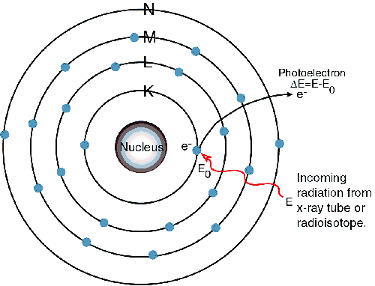
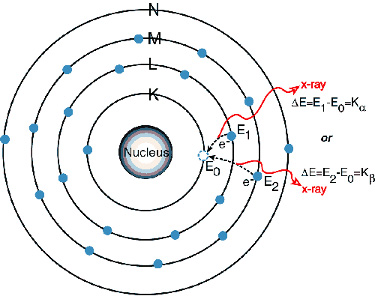
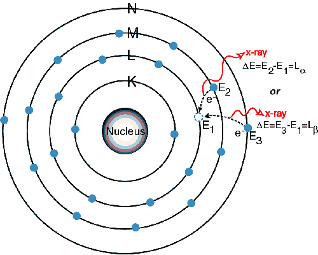
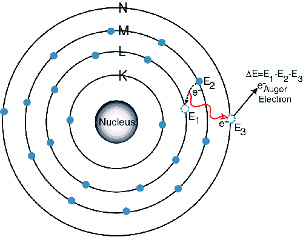
The “Auger” electron
Sometimes, instead of emitting a characteristic X-ray, the atom transfers its excitation energy directly to an outer electron, ejecting it. That ejected electron is called an Auger electron, a competing process to XRF that is more probable in low-Z elements such as aluminum and manganese than in high-Z elements such as tin, lead, or tungsten.
Common questions
What is XRF in simple terms?
What is XRF used for?
What are K lines and L lines?
What is an Auger electron?
Live information and alerts that mitigate costs, reduce risks, and potentially save lives.
Tell us what you need to monitor and we will help you design the right solution.
Request a Consultation